Content Menu
● Mastering Swimwear Fitting: Solving Strap Slippage and Shoulder Digging
● I. The Anatomy of Strap Slippage: Technical Diagnosis
>> 1. Root Causes
>> 2. Expert Fitting Solutions
● II. Diagnosing Shoulder Irritation: Why Straps Dig In
>> 1. Causes
>> 2. Process Optimization
● III. Industry Expert Insight: The Importance of Technical Documentation
● IV. Conclusion: Partnering for Perfection
● References
● FAQ
Mastering Swimwear Fitting: Solving Strap Slippage and Shoulder Digging
In the competitive world of swimwear production, the difference between a best-selling garment and a returned one often comes down to fit precision. For professional brands and retailers, swimwear is not merely a fashion statement—it is a functional "second skin" that must withstand movement, water resistance, and repeated wear.
At Dongguan Abely Fashion Co., Ltd., we understand that two of the most common consumer complaints—shoulder strap slippage and shoulder digging (skin irritation)—are not just minor annoyances; they are critical failures in pattern design and assembly quality. As a top-tier OEM partner, we approach these issues with rigorous engineering and expert fitting protocols.
I. The Anatomy of Strap Slippage: Technical Diagnosis
Strap slippage is a leading cause of customer dissatisfaction, significantly undermining the wearer's confidence in the water.
1. Root Causes
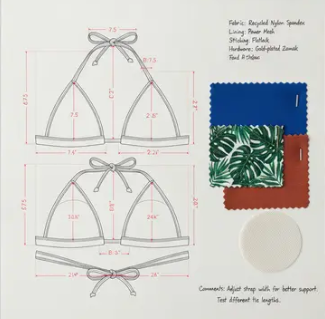
* Anatomical Misalignment: If the strap anchor points on the back panel are placed too wide, they extend beyond the wearer's acromion (the bony shoulder point), causing the straps to lose their natural anchor and slide outward.
* Insufficient Elastic Tension: Straps that lack the necessary elastic modulus or are cut too long fail to provide the upward lift required to secure the garment during active swimming or movement.
* Ignoring Body Geometry: Standardized mass-production patterns often fail to account for diverse shoulder slopes, particularly narrow or sloping shoulders that demand more precise, inward-set strap positioning.
2. Expert Fitting Solutions
When encountering strap slippage during the sampling phase, we employ a systematic, three-step correction process:
* Anchor Point Repositioning: We shift the strap connection points toward the center-back or front-center. Narrowing this span ensures the straps utilize the body's natural shoulder slope to "lock" into place.
* Precision Sizing Adjustments: We re-evaluate the strap length, making micro-adjustments in 0.5cm to 1cm increments based on real-time fit model feedback, ensuring tension is sufficient but not excessive.
* Structural Redesign: For high-performance needs, we recommend migrating from traditional parallel straps to X-back (cross-back) or racer-back configurations. These designs alter the force vectors, securing the straps centrally on the scapulae.
II. Diagnosing Shoulder Irritation: Why Straps Dig In
Strap-induced digging causes painful physical impressions and skin redness. This issue frequently stems from a "double failure" in pattern balance and manufacturing craft.
1. Causes
* Poor Weight Distribution: If the design places excessive bust weight on a narrow fabric strip, the localized pressure will inevitably lead to skin irritation.
* The "Front-Center Tether" Effect: A common, overlooked error is designing the front-center (the bridge between cups) too short. This creates a vertical "tether" that pulls the shoulders downward, exerting excessive, constant pressure.
* Stitching Integrity: The "hidden killer" in swimwear production. Seams that are too tight, or those using non-elastic, high-denier thread, create harsh, knife-like edges that abrade the skin during motion.
2. Process Optimization
To resolve digging, our expert team utilizes a forensic approach to production:
* Tension Testing: During fitting, we perform the "Two-Finger Test." A properly fitted strap should allow two fingers to slide underneath with slight resistance. If the resistance is absolute, the straps are too short.
* Pattern Balancing: We analyze the "Front-Center Chain Reaction." If the chest area is overly taut, we increase the front-center paper pattern to release the downward pull on the shoulder straps.
* Craftsmanship Upgrades: We implement 3-needle 5-thread coverstitch techniques to ensure seams are flat, soft, and flexible. By using high-stretch, skin-friendly threads and incorporating "turned-edge" or bonded (seamless) finishes, we eliminate potential friction points.
III. Industry Expert Insight: The Importance of Technical Documentation
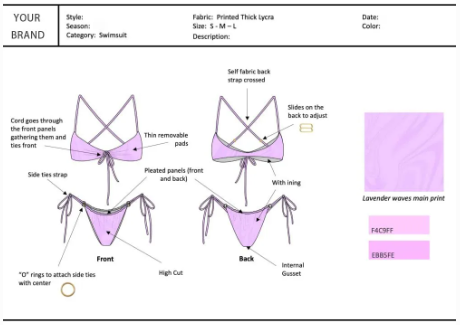
The difference between a "generic" factory and a high-end OEM partner lies in the Tech Pack. A comprehensive tech pack is the blueprint for quality, ensuring consistency from prototype to full-scale production.
| Critical Element | Impact on Fit | OEM Best Practice |
| Grading Rules | Prevents disproportionate fit across sizes | Use body-centric grading, not flat-pattern scaling |
| Seam Tolerance | Prevents seam-induced digging | Maintain strict tolerance of ±0.3mm swimsuitcustom |
| Elastic Quality | Prevents sagging and slippage | Use high-recovery, chlorine-resistant elastic nordstrom |
Pro Tip: Never skip the Dynamic Fitting stage. A swimsuit may look perfect on a static mannequin but fail during actual swimming. Our team performs active testing—involving overhead arm reaches and torso rotations—to verify that straps remain anchored throughout a full range of motion.
IV. Conclusion: Partnering for Perfection
In the swimwear industry, fit is not an option; it is the product. Whether addressing strap slippage or shoulder irritation, every detail—from the anchor point position to the thread tension—matters to the end user. At Dongguan Abely Fashion Co., Ltd., we bridge the gap between creative design and technical precision. We provide the expertise and manufacturing rigor that allow brands to focus on marketing while we ensure every piece provides unparalleled comfort and confidence.
Ready to elevate your swimwear collection? Contact our technical design team today for an audit of your current tech packs or to start your next high-performance development project. [Click here to partner with us for premium OEM services.](#)
---
FAQ
1. Why does my swimsuit strap keep sliding off despite being tight?
Often, the back anchor point is too wide. Even if the strap is tight, it cannot stay anchored if it is positioned outside your natural shoulder line.
2. Is there a difference between sewing thread for swimwear and regular clothes?
Yes. Swimwear requires specialized, high-stretch threads that won't snap under tension or act like a cutting blade against the skin during movement.
3. What is the "Two-Finger Test" in fitting?
It is a quick check where a technician slides two fingers under the strap. It should be snug, but not painful or impossible to pull through.
4. How does "Front-Center Length" affect shoulder pain?
If the front-center is too short, it acts like a rope, pulling the entire garment downward and digging the straps into your shoulders.
5. How can Dongguan Abely Fashion Co., Ltd. help my brand?
We offer professional OEM services, specializing in pattern engineering, tech pack optimization, and rigorous QC to ensure your swimwear fits perfectly, minimizing returns.