Content Menu
● The Engineering of Opacity: Why Lining Strategies Differ for Dark vs. Light Swimwear
● The Physics of Opacity: Why Light Colors Are Vulnerable
● The Essential Case for Full Lining in Light-Colored Swimwear
● Why Dark-Colored Swimwear Can Rely on Gusset-Only Linings
● The Role of Consumer Perception and Perceived Value
● Manufacturing and Technical Considerations
● Strategic Decision Matrix
● Conclusion
● References
● Frequently Asked Questions (FAQ)
The Engineering of Opacity: Why Lining Strategies Differ for Dark vs. Light Swimwear
In the world of professional swimwear manufacturing, the interior of a garment is just as crucial as the design on the outside. At Dongguan Abely Fashion Co., Ltd., we consult with brands daily on the technical intricacies of garment construction. A frequent point of debate during the product development phase is the swimwear lining strategy: Why do dark-colored one-piece swimsuits often function perfectly with only a gusset lining, while light-colored swimsuits almost universally require a full interior lining?
This design decision is far from arbitrary. It is deeply rooted in the physics of light, the chemistry of textile performance, and the psychology of consumer confidence. Understanding these technical principles is the key to producing high-quality, commercially successful swimwear that stands up to the rigors of the beach and the pool.
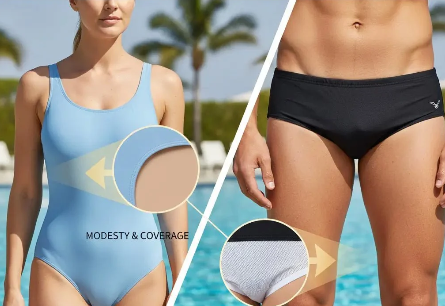
The Physics of Opacity: Why Light Colors Are Vulnerable
The primary factor driving lining decisions is opacity—the garment's inherent ability to hide the body beneath the fabric.
When high-quality swimwear fabric (typically a nylon/elastane or polyester/elastane blend) is in a dry, relaxed state, it covers the body effectively. However, swimwear is engineered for stretch. When the fabric expands to conform to the wearer's curves, the structural gaps between the knit yarns widen.
* Light Transmission: Lighter-colored fabrics—whites, pastels, yellows, and light pinks—possess low light-absorption properties. As these fabrics stretch, and especially when they become saturated with water, they allow significant light to pass through the expanded knit structure. This makes them highly susceptible to unwanted transparency.
* The "Wet-Out" Effect: Once a swimsuit is submerged, the refractive index of the water fills the microscopic air gaps in the fabric. This process, known as "wet-out," effectively makes the fabric appear more translucent. For light-colored garments, this is a critical technical failure point that brands must preemptively manage [1, 2].
The Essential Case for Full Lining in Light-Colored Swimwear
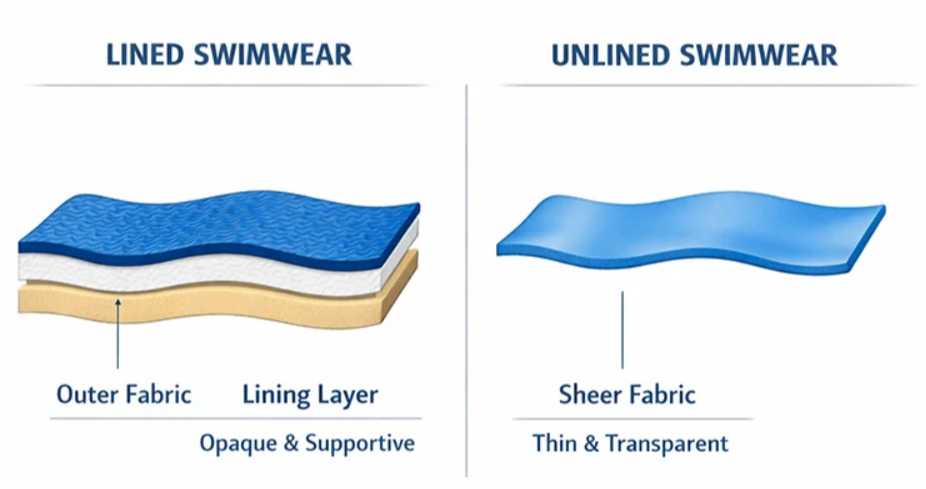
To combat the inherent transparency of light-colored textiles, a full lining (covering front and back panels) is non-negotiable for premium brands.
1. Creating a Secondary Opacity Shield: A full lining acts as an essential second layer. Even if the outer shell fabric becomes slightly translucent when wet, the solid-colored lining provides a reliable, opaque barrier that prevents the skin from being visible.
2. Maintaining Color Fidelity: A light-colored shell fabric can look "washed out" or uneven if the wearer's skin tone shows through. A high-quality full lining ensures the exterior color remains consistent, opaque, and true to the designer's intent.
3. Enhanced Silhouette and Support: Consumers selecting light-colored swimsuits often desire a clean, minimalist aesthetic. A full lining adds the necessary density to the garment, providing a smoother silhouette and better compression, which are hallmark expectations of high-end swimwear [1, 2].
Why Dark-Colored Swimwear Can Rely on Gusset-Only Linings
Conversely, dark-colored swimwear—including black, navy, charcoal, or deep plum—operates under a different set of physical laws.
* High Light Absorption: Dark pigments absorb light rather than reflecting or transmitting it. This inherent characteristic makes dark fabrics significantly more opaque by design. Even when stretched during high-intensity swimming, dark fabrics retain a high degree of coverage that lighter alternatives simply cannot match without additional help.
* Strategic Gusset Lining: In dark swimwear, the primary goal is hygiene rather than opacity. The gusset is the high-friction, high-moisture zone that requires a protective barrier for sanitary reasons. By focusing the lining exclusively on this area, the garment remains lightweight, breathable, and comfortable for the wearer, while still meeting all necessary standards for public wear [1, 2].
The Role of Consumer Perception and Perceived Value
Beyond the physics of textiles, there is the consumer experience.
* Perceived Quality: Consumers almost instinctively associate fully-lined garments with higher quality craftsmanship. For light-colored swimwear, a full lining is not just a technical requirement; it is a quality signal. If a white or pastel swimsuit is unlined or only partially lined, it is often perceived as "cheap" or "disposable" by the modern shopper.
* Psychological Confidence: The most critical performance metric for a swimsuit is whether the wearer feels "safe." A fully-lined light-colored suit provides the psychological security that no unexpected transparency will occur, regardless of movement, stretching, or water conditions [2].
Manufacturing and Technical Considerations
For OEM partners and brand owners, the construction approach must be a strategic balance of cost, performance, and durability:
* Material Density (GSM): If a brand insists on using light-colored fabrics, developers must select high-density knits with a higher GSM (grams per square meter) to improve baseline opacity. However, even with high-GSM fabrics, a full lining remains the safest, most reliable route for light colors.
* The Risk of Dye Migration: One critical risk when using a full lining in a light-colored suit is dye migration. If the lining is a low-quality, poorly dyed fabric, it can "bleed" into the light shell fabric over time. Dongguan Abely Fashion Co., Ltd. strongly recommends using high-grade, chlorine-resistant lining materials that are rigorously tested for colorfastness [1].
Strategic Decision Matrix
| Feature |
Dark Swimwear |
Light Swimwear |
| Primary Risk |
Staining/Hygiene |
Transparency/Opacity |
| Lining Strategy |
Gusset-only (often sufficient) |
Full Lining (highly recommended) |
| Consumer Expectation |
Minimalist, streamlined |
Secure, opaque, premium |
| Development Focus |
Fit & Comfort |
Opacity & Structural Integrity |
Conclusion
At Dongguan Abely Fashion Co., Ltd., we view swimwear construction as a precise balance of science and design. While dark-colored swimwear offers the versatility of minimalist, gusset-only construction, light-colored swimwear demands the technical rigor of a full interior lining. By adhering to these rigorous construction standards, brands can ensure their products not only look beautiful but perform flawlessly in the water, maintaining both the wearer's confidence and the brand's reputation for enduring quality.
Are you looking to optimize your swimwear production line? [Contact Dongguan Abely Fashion Co., Ltd. today](mailto:info@abelyfashion.com) for expert OEM guidance on technical construction and high-performance material sourcing.
References
1. [Sportek: Swimwear Lining Purpose – Why Linings Matter in Construction]
2. [Doll House: Features of Quality Swimwear: Key Traits for Lasting Style]
Frequently Asked Questions (FAQ)
1. Can I use a partial lining for light-colored swimsuits to save production costs?
It is generally not recommended. Partial lining in light colors frequently leads to "show-through" in the unlined areas, resulting in higher return rates and a damaged brand reputation.
2. Does adding a full lining make the swimsuit uncomfortably hot?
Not if you choose the right materials. Modern moisture-management linings are thin, breathable, and designed to wick moisture away, ensuring comfort despite the extra layer.
3. Is it true that dark colors don't need *any* lining at all?
While they are much more opaque, a gusset lining is still essential for hygiene and comfort, even in the darkest garments.
4. How do I ensure the lining won't show through the light-colored shell fabric?
Use "skin-tone" or perfectly color-matched linings, and ensure your shell fabric has a high enough GSM to mask the lining underneath.
5. Which is more durable, a single-layer or a double-layer swimsuit?
Double-layer (fully lined) swimsuits generally last longer. The internal lining takes the brunt of the mechanical stress and stretching, effectively protecting the outer shell fabric from premature wear.
Brief Summary:
This article details the technical reasoning behind professional swimwear lining strategies. It explains why light-colored fabrics necessitate full linings to prevent transparency, while dark-colored fabrics leverage natural light absorption to allow for more streamlined, gusset-only construction, balancing hygiene, opacity, and consumer confidence.