Content Menu
● Why Swimsuit Front Rise Lifts: Expert Fit Diagnosis and OEM Solutions
● Swimsuit front rise lifting—sometimes described as a swimsuit riding up, front crotch pulling, or excess fabric gathering at the lower abdomen—is one of the most misunderstood fit problems in swimwear. Many people assume the garment is too large because they see wrinkles or loose fabric. In professional swimwear patternmaking, however, the opposite is often true: the front body length is too short for the wearer's three-dimensional body shape.
● 1. The front body length is too short
● 2. Bust projection changes the required length
● 3. Shoulder straps may be pulling the garment upward
● 4. Leg-opening elastic may be too strong
● 5. Fabric stretch and recovery are influencing the fit
● Step 1: Check the front and back hem relationship
● Step 2: Test the garment in motion
● Step 3: Check strap tension
● Step 4: Perform a controlled pull-down test
● Step 5: Compare fabric strain
● Add front length—but do it structurally
● Adjust the front hem curve
● Review bust shaping
● Balance the front and back pattern
● Recommended development sequence
● Mistake 1: Automatically choosing a smaller size
● Mistake 2: Removing lower-front fabric
● Mistake 3: Tightening every elastic
● Mistake 4: Testing only on a mannequin
● Mistake 5: Ignoring the lining
● Suggested image placements
● AI image prompts
● 1. Does front rise lifting mean my swimsuit is too big?
● 2. Should I simply add length to the front pattern?
● 3. Why does my swimsuit fit while standing but ride up when walking?
● 4. Can fabric cause a swimsuit to ride up?
● 5. How can brands prevent this problem during OEM development?
● 6. Is front rise lifting common in bikinis and thongs?
● 7. What information should I send an OEM factory?
● Conclusion
Why Swimsuit Front Rise Lifts: Expert Fit Diagnosis and OEM Solutions
Swimsuit front rise lifting—sometimes described as a swimsuit riding up, front crotch pulling, or excess fabric gathering at the lower abdomen—is one of the most misunderstood fit problems in swimwear. Many people assume the garment is too large because they see wrinkles or loose fabric. In professional swimwear patternmaking, however, the opposite is often true: the front body length is too short for the wearer's three-dimensional body shape.
For brands, wholesalers, and manufacturers, this distinction matters. A smaller size will not necessarily solve the problem. It may increase vertical tension, pull the front rise higher, and make the garment less comfortable in motion.
At Dongguan Abely Fashion Co., Ltd., an OEM swimwear manufacturer specializing in bikinis, one-piece swimsuits, swim shorts, and thongs, we view this issue as a force-distribution problem involving pattern length, breast projection, strap tension, leg opening elasticity, and fabric recovery.
> Important terminology: In this article, "front rise lifting" refers to the front section of a swimsuit being pulled upward, not a deliberate high-rise design feature.
What Is Swimsuit Front Rise Lifting?
A swimsuit has front rise lifting when the front center, crotch, or lower front hem sits noticeably higher than intended. Typical signs include:
- Diagonal wrinkles extending from the bust toward the hip or crotch.
- Tension across the abdomen or front waist.
- A front hem that is visibly higher than the back hem.
- Excess fabric near the front leg opening or inner thigh.
- Discomfort when sitting, squatting, walking, or raising the legs.
- A thong or bikini bottom that shifts upward during movement.
The visual appearance can be confusing. The lower front may look as if it contains too much fabric, while the real problem is that the garment has insufficient vertical length above it.
Swimwear is usually designed with controlled negative ease: the finished garment is smaller than the body measurement so the fabric stretches and stays close to the body. This makes fit more sensitive than in loose clothing.
Why Does the Front of a Swimsuit Ride Up?
1. The front body length is too short
The most common cause is insufficient front center length or front rise length.
The human torso is not flat. The fabric must travel over the bust projection, abdomen, pelvis, and crotch. If a pattern is developed from a simple vertical measurement without enough allowance for body curvature, the garment may become tight over the bust and waist.
Because the fabric cannot extend downward, it seeks another direction. It pulls upward from the lower front and redistributes tension through the side seams, shoulder straps, and leg openings.
The result is a familiar contradiction:
- The bust and abdomen look tight.
- The front crotch appears to have extra fabric.
- The front hem rides upward.
The fabric has not become longer or wider. It has been pulled out of its intended position.
2. Bust projection changes the required length
For a fuller bust, the distance from the neckline to the waist is not equivalent to the same measurement on a flat body. The fabric must cover a curved surface, and that curve consumes additional length.
If the pattern does not account for:
- Bust projection
- Cup volume
- A longer torso
- A prominent abdomen
- A deeper front pelvis
- A fuller seat or hip
the front section may be structurally short even when the overall size appears correct.
This is why body measurements alone are not enough. A professional fit review must evaluate the relationship between length, width, volume, and stretch.
3. Shoulder straps may be pulling the garment upward
A swimsuit can have adequate front length but still ride up if the straps are too short or too tight.
Short straps create an upward force at the shoulder. That force transfers through the bust area and pulls the front body higher. The problem is especially visible in:
- One-piece swimsuits
- High-neck swimsuits
- Racerback styles
- Swimsuits with fixed straps
- Styles with heavy bust cups or underbust support
For this reason, strap adjustment should always be checked before changing the entire pattern.
4. Leg-opening elastic may be too strong
Elastic is essential for security, but excessive tension at the leg opening can create an upward pull. If the leg elastic is too short, too firm, or applied with excessive gathering, it may pull the crotch and front body toward the leg opening.
A fit technician should review:
- Elastic recovery
- Cut length
- Application ratio
- Elastic width
- Leg-opening curve
- Seam allowance bulk
A strong elastic is not automatically a better elastic. The goal is controlled recovery without upward distortion.
5. Fabric stretch and recovery are influencing the fit
Swimwear fabric is not passive. It stretches, recovers, and distributes tension differently depending on fiber content, construction, weight, and direction.
Polyester-spandex fabrics are often selected for durability and chlorine resistance, while nylon-spandex fabrics are valued for softness and flexibility. Chlorine, saltwater, oils, and repeated wear can gradually reduce elastane recovery.
A production sample may therefore fit differently:
- Before washing
- After repeated pool exposure
- When wet
- After sunscreen contact
- After heat drying
- When stretched across the cross-grain
A reliable development process must evaluate both the initial fit and the expected end-of-life fit.
How to Diagnose the Problem During a Fit Session
A professional fitting should not rely on standing still in front of a mirror. Swimwear needs to be assessed in multiple positions.
Step 1: Check the front and back hem relationship
Ask the fit model to stand naturally and turn sideways.
Observe whether:
- The front hem is higher than the back hem.
- The crotch seam is being pulled forward.
- The side seams angle upward.
- The back body appears to have enough length.
A small difference may be acceptable in a deliberately shaped design, but an unexpected front-high/back-low appearance indicates possible vertical tension.
Step 2: Test the garment in motion
Ask the model to perform the following movements:
1. Raise both arms.
2. Walk naturally.
3. Sit down.
4. Bend forward.
5. Squat.
6. Raise one knee.
7. Lift both legs separately.
After each movement, observe whether the wrinkles disappear or remain.
- Wrinkles that recover quickly may be normal temporary compression.
- Wrinkles that remain fixed suggest incorrect pattern balance, excessive elastic tension, or inadequate length.
- A crotch that continues moving upward indicates that the garment is not distributing vertical tension correctly.
Step 3: Check strap tension
Loosen the straps slightly without changing the size.
If the front body drops into a more natural position, the original strap length may be too short. If nothing changes, investigate the front length, bust shaping, side seam, or leg elastic.
Step 4: Perform a controlled pull-down test
With the wearer standing comfortably, gently pull the front fabric downward.
If the wrinkles and front rise lifting improve immediately, this is strong evidence that the garment needs more usable vertical length.
This does not mean the pattern should simply be lengthened vertically. The additional length must be integrated into the garment's three-dimensional shape.
Step 5: Compare fabric strain
Use a simple visual strain map or, during advanced development, a fabric strain-measurement system.
Look for:
- High strain over the bust apex
- Tension radiating toward the side seam
- Low contact or loose fabric at the lower front
- Distortion around the leg opening
- Unequal tension between front and back
A more advanced factory can combine fitting observations with fabric stretch testing, seam-strength checks, and wash testing.
How Patternmakers Correct Front Rise Lifting
Add front length—but do it structurally
If the front body is too short, the first correction is usually to add length along the front center or front rise. However, a simple horizontal extension may create new problems.
The added length may need to be redistributed through:
- A shaped center-front line
- A princess seam
- A side panel
- A bust cup
- A controlled waist curve
- A slightly deeper front hem
- A revised crotch curve
The objective is to create enough length over the body's curved areas without producing looseness elsewhere.
Adjust the front hem curve
A completely straight front hem may not suit every body type. A subtle downward curve can create more space for bust and abdominal projection.
This adjustment is especially useful for:
- Long-torso customers
- Full-bust customers
- Maternity-inspired silhouettes
- High-support one-piece designs
- Athletic bodies with strong torso development
Review bust shaping
When a swimsuit has a larger bust cup or molded padding, the front pattern may need additional volume. Options include:
- Increasing cup depth
- Repositioning a bust dart
- Using a princess seam
- Adding a contoured underbust panel
- Changing the neckline angle
- Adjusting the bust apex location
A garment can be wide enough but still short in the wrong direction. Bust shaping must therefore be evaluated in both horizontal and vertical dimensions.
Balance the front and back pattern
The front and back pieces work as a connected system. Adding front length may require a corresponding review of:
- Back rise
- Side seam length
- Waistline position
- Crotch extension
- Seat coverage
- Leg-opening shape
The correction should preserve the intended coverage and prevent the swimsuit from shifting toward the back.

A Practical OEM Fit-Approval Workflow
For international brands and wholesalers, front rise lifting should be addressed before bulk production.
Recommended development sequence
1. Confirm the target customer profile.
Define torso length, bust range, hip proportion, coverage preference, and intended use.
2. Select the fabric before finalizing the pattern.
Record composition, GSM, stretch percentage, recovery, lining behavior, and stretch direction.
3. Create a base sample in the actual production fabric.
A substitute fabric may produce misleading results.
4. Fit on at least two body shapes.
One model cannot represent the full target market.
5. Test dry and wet conditions.
Wet fabric may change weight, cling, and tension.
6. Test movement, not only posture.
Include sitting, bending, squatting, walking, and arm movement.
7. Check the sample after laundering.
Confirm that the garment retains shape and recovery.
8. Record every correction numerically.
Document front length, strap length, elastic ratio, cup depth, and seam changes.
9. Approve a size-set sample.
A successful medium size does not guarantee successful grading.
10. Conduct a pre-production inspection.
Confirm that cutting, elastic application, sewing tension, and measurements match the approved sample.
This workflow turns a subjective complaint—"the swimsuit rides up"—into measurable development actions.
Common Mistakes That Make the Problem Worse
Mistake 1: Automatically choosing a smaller size
A smaller size increases tension throughout the garment. It may make the front body shorter relative to the wearer and intensify the lifting effect.
Mistake 2: Removing lower-front fabric
If the visible folds are caused by upward displacement, removing fabric from the lower front can worsen the imbalance.
Mistake 3: Tightening every elastic
More tension does not always mean more support. Excessive elastic can pull the garment upward and create discomfort.
Mistake 4: Testing only on a mannequin
A mannequin cannot reproduce breathing, body movement, soft tissue compression, or individual posture. Real fit approval requires live-model testing.
Mistake 5: Ignoring the lining
A lining with different stretch or recovery from the shell fabric can pull the outer layer out of position. Shell, lining, elastic, and thread must function as one system.
Visual Content Recommendations
To make this article easier to understand, consider adding the following original visual assets.
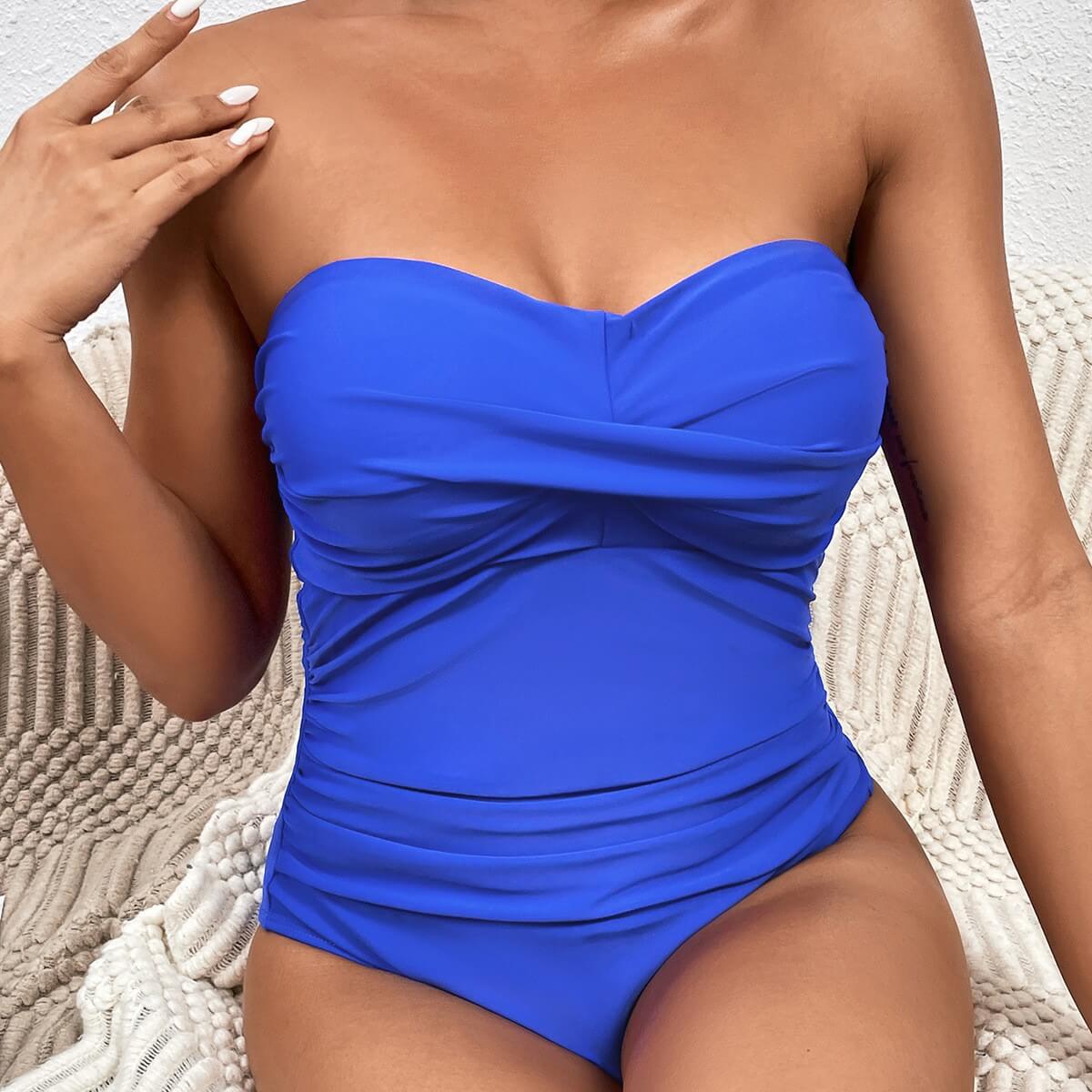
Suggested image placements
- After the introduction: A side-by-side illustration showing correct front balance versus front rise lifting.
- After the diagnosis section: A labeled technical diagram showing the bust apex, front center length, side seam, crotch, and leg opening.
- After the correction section: A patternmaking illustration comparing a standard front piece with a lengthened and reshaped version.
- Before the CTA: A factory fit-session photograph showing a technician evaluating a swimsuit sample.
- Optional video: A 45–60 second demonstration of a live-model movement test
OEM Support for Better Swimwear Fit
A reliable OEM partner should do more than reproduce a sketch. The factory should help identify whether a fit issue comes from:
- Pattern geometry
- Fabric performance
- Elastic selection
- Construction tension
- Size grading
- Padding or lining
- Customer body-shape variation
At Dongguan Abely Fashion Co., Ltd., brands can use a structured development process for custom bikinis, one-piece swimsuits, swim shorts, thongs, and other private-label swimwear. The most useful starting materials are:
- Technical drawings or reference samples
- Target measurements and size range
- Fabric composition and performance requirements
- Desired coverage and support level
- Intended market and customer profile
- Photos or videos of the fit issue
Planning a new swimwear collection? Send your tech pack, reference garment, or fit concern for an OEM review focused on pattern balance, fabric selection, construction, and production feasibility.
Frequently Asked Questions
1. Does front rise lifting mean my swimsuit is too big?
Not necessarily. In many cases, the front body is too short, or the straps and leg elastic are pulling the garment upward. A smaller size may increase tension and make the problem worse.
2. Should I simply add length to the front pattern?
Adding length may be necessary, but it should be integrated with bust shaping, front hem curvature, crotch balance, and side-seam length. A straight extension can create unwanted looseness.
3. Why does my swimsuit fit while standing but ride up when walking?
Standing still does not reveal how forces change during movement. Walking, sitting, squatting, and lifting the legs expose problems in front length, strap tension, elastic recovery, and pattern balance.
4. Can fabric cause a swimsuit to ride up?
Yes. Incorrect stretch direction, poor recovery, excessive compression, or a lining that does not match the shell can all affect fit. Chlorine, saltwater, oils, and heat may also reduce elastic recovery over time. [peekaboopatternshop]
5. How can brands prevent this problem during OEM development?
Use the actual production fabric, fit on multiple body shapes, test both dry and wet conditions, evaluate movement, record measurable corrections, and approve a complete size set before bulk production.
6. Is front rise lifting common in bikinis and thongs?
Yes. Smaller coverage styles have less fabric available to distribute tension, so front length, crotch extension, leg-opening elastic, and body-shape compatibility become especially important.
7. What information should I send an OEM factory?
Provide the target measurements, fabric details, technical drawings, reference samples, desired support level, coverage requirements, and photos or videos showing the fit problem.