Content Menu
● Quick Answer: What Does Swimwear Fit Testing Check?
● Dry Versus Wet Fit Checklist
● Construction Features That Influence Support
● Step 1: Define the Product Brief
● Step 2: Build the Measurement Chart
● Step 3: Conduct the First Dry Fitting
● Step 4: Perform Movement Testing
● Step 5: Conduct Wet Testing
● Step 6: Perform Wear Testing
● Step 7: Test Washing and Recovery
● Step 8: Correct the Pattern and Construction
● Step 9: Approve the Pre-Production Sample
● Recommended Visual Content
● 1. How many times should a swimsuit be fit-tested?
● 2. Should swimwear be tested when wet?
● 3. Is fit testing necessary for bikinis and thongs?
● 4. How should plus-size swimwear be fit-tested?
● 5. Can good fabric eliminate the need for fit testing?
● 6. What information should a brand give an OEM factory?
● 7. Does fit testing help reduce returns?
Swimwear fit testing is essential for creating swimsuits that stay secure, remain comfortable, and perform reliably in real conditions. Unlike ordinary clothing, bikinis, one-piece swimsuits, swim shorts, and thongs must handle water, body movement, repeated stretching, sunlight, and prolonged wear.
A swimsuit that looks perfect on a mannequin may still ride up, lose support, become transparent when wet, or place uncomfortable pressure on the body. For brands, wholesalers, and OEM buyers, professional swimwear fit testing helps detect these problems before bulk production.
At Dongguan Abely Fashion Co., Ltd., we treat fit testing as part of product engineering—not merely a final appearance check. A successful swimsuit should fit the body, support its intended use, and preserve its performance after repeated wear.
Quick Answer: What Does Swimwear Fit Testing Check?
Professional testing evaluates whether a swimsuit:
- Fits accurately across the target size range
- Remains stable during movement
- Provides the intended bust and body coverage
- Maintains comfort when wet
- Resists shifting, rolling, pinching, and ride-up
- Preserves stretch and shape recovery
- Performs after washing and repeated use
- Meets agreed quality and market requirements
ASTM performance specifications for certain seamless garments, including swimwear, identify properties such as stretch, dimensional change, seam or fabric strength, colorfastness to seawater and chlorinated pool water, and fiber content as relevant performance considerations.
1. Swimwear Must Fit During Movement, Not Only When Standing
Customers do not wear swimsuits like display garments. They swim, walk, sit, bend, stretch, dive, climb out of pools, and play beach sports.
A fit test should therefore include movement such as:
- Raising both arms
- Bending forward
- Sitting and squatting
- Walking and twisting
- Stretching the torso
- Simulating swimming strokes
- Entering and exiting the water
During these movements, the technical team should observe whether:
- Straps remain in place
- Bust coverage stays secure
- Leg openings remain comfortable
- Waistbands stay flat
- The back does not ride upward
- The gusset remains correctly positioned
- Seams create pressure or irritation
A swimsuit that fits only while standing still is not fully tested. Real fit means stable performance across realistic body positions.
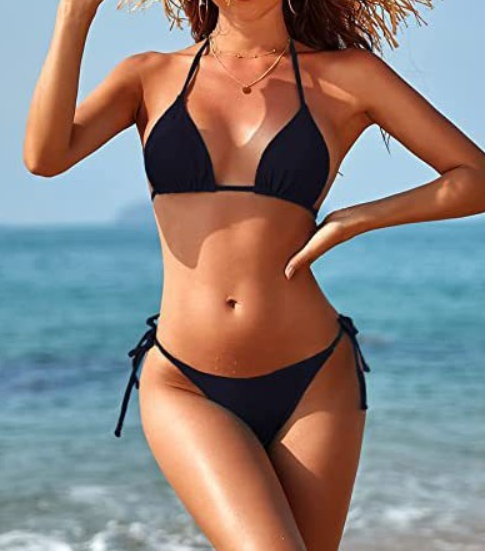
2. Wet Conditions Can Change the Fit
Fabric does not always behave the same way when dry and wet. Water can affect weight, stretch, opacity, softness, support, and recovery.
This matters particularly for:
- White and light-colored swimwear
- Unlined or lightly lined bikinis
- Cut-out designs
- Plus-size swimwear
- High-waisted bottoms
- Minimal-coverage bikini and thong styles
- Swim shorts made with lightweight materials
A dry fitting cannot confirm wet performance. The garment should be assessed after soaking or controlled water exposure for:
1. Opacity
2. Coverage
3. Bust support
4. Waistband stability
5. Leg-opening comfort
6. Fabric weight
7. Shape recovery
8. Color transfer or fading
Colorfastness is especially relevant to swimwear because chlorine, seawater, washing, rubbing, perspiration, and sunlight can cause fading or dye transfer. Textile testing organizations identify dedicated methods for evaluating resistance to chlorinated water and seawater.
Dry Versus Wet Fit Checklist
| Test area | Dry evaluation | Wet evaluation |
| Coverage | Check pattern dimensions | Check transparency and exposure |
| Support | Assess initial tension | Check whether support weakens |
| Waistband | Observe flatness | Check rolling under added weight |
| Straps | Confirm placement | Check slipping and stretching |
| Fabric | Review hand feel | Assess weight and recovery |
| Color | Check visual appearance | Assess bleeding or transfer |
3. Plus-Size Fit Requires More Than Simple Pattern Grading
A common development mistake is enlarging a smaller-size pattern without reconsidering its proportions. Bodies do not scale evenly in every direction.
A larger-size swimsuit may require changes to:
- Bust and cup volume
- Underbust length
- Torso length
- Front and back rise
- Waist and abdomen shaping
- Hip and seat proportions
- Thigh circumference
- Strap position
- Elastic tension
- Lining and power-mesh placement
Two customers who purchase the same size may have different bust, abdomen, hip, and torso proportions. That is why fit approval based on one model is risky.
For plus-size swimwear, brands should consider:
- Separate bikini top and bottom sizing
- Adjustable straps
- Long-torso options
- Wider underbust bands
- Double-layer construction
- Targeted power mesh
- Higher rises
- Leg openings shaped to the thigh
The objective is not to make the garment excessively tight. The objective is to provide controlled support without restricting breathing or movement.
4. Fit Testing Confirms Support Without Excessive Compression
A swimsuit should remain secure because of good pattern engineering and construction—not because it is painfully tight.
A professional fitting should evaluate:
- Underbust stability
- Cup depth and coverage
- Strap width and pressure
- Back support
- Abdominal comfort
- Gusset width
- Elastic recovery
- Ease of dressing and undressing
For fuller busts, a stable underbust band, suitable cup volume, wide adjustable straps, and an appropriate back design can distribute support more effectively than simply reducing the garment's measurements.
Construction Features That Influence Support
| Feature | Primary function |
| Wide underbust band | Stabilizes the bust area |
| Adjustable straps | Accommodates different torso lengths |
| Power mesh | Adds targeted control |
| Double-layer fabric | Improves coverage and stability |
| Internal shelf bra | Provides additional support |
| Wide waistband | Reduces rolling and pressure |
| Enclosed elastic | Improves comfort against the skin |
| Shaped gusset | Supports mobility and comfort |
5. It Identifies Problems Before Customers Do
Many common complaints are symptoms of specific technical issues.
| Customer complaint | Likely cause | Potential correction |
| “The swimsuit rides up.” | Short torso or insufficient back rise | Adjust vertical measurements |
| “The straps keep falling.” | Incorrect angle or placement | Reposition or add adjustability |
| “The waistband rolls.” | Narrow waistband or weak structure | Increase width or revise elastic |
| “The leg openings dig in.” | Excessive elastic tension | Modify curve and tension |
| “The bust spills out.” | Insufficient cup depth | Increase coverage or cup volume |
| “The fabric is see-through.” | Poor lining or unsuitable fabric | Add lining or change material |
| “It loses shape.” | Weak recovery or construction | Review fabric, elastic, and seams |
| “It feels uncomfortable after an hour.” | Pressure concentrated in one area | Redistribute support and tension |
Testing allows the factory and brand to determine whether the solution involves the pattern, fabric, lining, elastic, seam construction, or sewing process.
6. Fabric and Construction Testing Should Work Together
Testing only the fabric is not enough. A fabric may perform well in isolation but fail when combined with a particular lining, elastic, seam, or panel design.
For swimwear development, evaluate:
- Two-way or four-way stretch
- Stretch recovery
- Seam strength
- Elastic recovery
- Dimensional change
- Wet opacity
- Colorfastness
- Resistance to chlorine and seawater
- Pilling or surface damage
- Care-label accuracy
ASTM, AATCC, ISO, and third-party laboratories provide textile test methods and performance frameworks, but the appropriate requirements depend on the product category, target market, material, and buyer specification. A standard should not be presented as a universal guarantee; the brand and supplier should agree on the applicable tests and acceptance criteria.
7. A Professional Swimwear Fit-Testing Workflow
A reliable workflow should combine technical measurement, human feedback, movement testing, and performance evaluation.
Step 1: Define the Product Brief
Before sampling, confirm:
- Target customer
- Market and country
- Intended use
- Size range
- Coverage level
- Support level
- Fabric composition
- Lining requirements
- Hardware and trim
- Care instructions
Step 2: Build the Measurement Chart
Define the body measurements, garment measurements, tolerances, and grading increments. Include vertical measurements such as torso length and rise, not only bust, waist, and hip circumference.
Step 3: Conduct the First Dry Fitting
Check the sample on appropriate fit models. Observe the garment from the front, side, and back while standing and moving.
Step 4: Perform Movement Testing
Use a consistent series of movements. Record the exact position that causes slipping, pinching, exposure, or restriction.
Step 5: Conduct Wet Testing
Soak the garment or test it in controlled water conditions. Assess opacity, support, weight, recovery, and stability.
Step 6: Perform Wear Testing
Ask the model to wear the swimsuit for an extended period. Record discomfort that may not appear during a short fitting.
Step 7: Test Washing and Recovery
Evaluate whether the swimsuit maintains its measurements, elasticity, color, lining, and seam appearance after agreed care cycles.
Step 8: Correct the Pattern and Construction
Do not make random changes. Link every correction to a recorded observation, such as:
- "Left strap slips during arm elevation."
- "Waistband rolls after sitting."
- "Front lining becomes transparent when wet."
- "Torso tension increases at the center front."
Step 9: Approve the Pre-Production Sample
Bulk production should begin only after the final sample meets the agreed requirements for fit, comfort, appearance, performance, and construction quality.
8. Why Multiple Fit Models Are Essential
One fit model cannot represent an entire size range or all body shapes.
A stronger test group may include models with differences in:
- Bust-to-waist ratio
- Torso length
- Hip and seat shape
- Abdomen distribution
- Height
- Thigh circumference
- Shoulder width
- Mobility needs
For inclusive swimwear, brands should test at least the core size, smallest planned size, and largest planned size, then review whether grading behaves consistently between those points.
Feedback should be categorized rather than collected as a general opinion:
- Coverage
- Support
- Comfort
- Mobility
- Strap stability
- Waistband behavior
- Leg-opening pressure
- Wet opacity
- Dressing difficulty
- Visual balance
This creates a clearer technical record and reduces subjective debates during revisions.
9. New Product Insight: Treat Fit Testing as a Return-Reduction Tool
Fit testing should not be viewed only as a sample-room expense. It is also a way to protect the commercial performance of a product.
A return review can be converted into a fit issue database. For example:
| Return or review pattern | Product-development action |
| Repeated “short torso” comments | Add torso length options |
| Frequent “tight leg opening” feedback | Rework curve and elastic tension |
| Different top and bottom fit complaints | Offer separates |
| Wet transparency complaints | Improve lining and opacity testing |
| Strap-slipping complaints | Add adjustment or revise angle |
This creates a feedback loop:
Customer feedback → technical diagnosis → pattern revision → fit testing → improved product.
The most valuable customer reviews are not simply positive or negative. They explain where, when, and why the product succeeds or fails.
10. How OEM Buyers Can Make Fit Testing More Efficient
For brands working with a swimwear OEM manufacturer, a complete technical package reduces sampling time and misunderstandings.
Share:
- Target market and customer profile
- Size chart
- Garment measurement chart
- Reference sample
- Technical sketch
- Support and coverage expectations
- Fabric and lining specifications
- Fit-model measurements
- Intended activities
- Previous customer complaints
- Required compliance or laboratory tests
At Dongguan Abely Fashion Co., Ltd., feedback is most useful when separated into technical categories. Instead of saying "please improve the fit," specify whether the issue concerns the bust, torso, waist, hip, rise, leg opening, strap, support, or comfort.
Recommended Visual Content
Add the following assets to improve user experience:
1. Measurement diagram: Label bust, underbust, torso, waist, hip, and rise.
2. Movement sequence: Show how the garment performs in four or five positions.
3. Wet-test video: Demonstrate opacity, support, and fabric recovery.
4. Pattern comparison: Show standard grading versus plus-size-specific adjustments.
5. Fit-feedback chart: Map customer complaints to technical solutions.
6. Factory process video: Show prototype fitting, revision, and pre-production approval.

Frequently Asked Questions
1. How many times should a swimsuit be fit-tested?
At minimum, test the first prototype, revised sample, and pre-production sample. Add wet and wear testing before approval.
2. Should swimwear be tested when wet?
Yes. Wet testing can reveal changes in opacity, weight, support, coverage, stretch, and garment stability that are not visible during a dry fitting.
3. Is fit testing necessary for bikinis and thongs?
Yes. Minimal-coverage styles require particularly careful testing of coverage, waistband stability, side-seam tension, gusset comfort, and movement security.
4. How should plus-size swimwear be fit-tested?
Use multiple fit models with different proportions and assess torso length, bust volume, rise, abdomen comfort, hip shaping, thigh pressure, support, and movement.
5. Can good fabric eliminate the need for fit testing?
No. Fabric performance cannot correct an unsuitable pattern, incorrect elastic tension, poor seam placement, or inaccurate grading.
6. What information should a brand give an OEM factory?
Provide the target market, size chart, technical drawings, fabric details, lining requirements, intended use, support level, fit-model measurements, and previous customer feedback.
7. Does fit testing help reduce returns?
It can identify recurring fit and performance problems before production, helping brands improve product consistency and reduce preventable complaints. The actual effect depends on testing quality and how accurately the findings are implemented.
Call to Action
Are you developing a new bikini, one-piece swimsuit, plus-size swimwear collection, swim short, or thong style?
Send Dongguan Abely Fashion Co., Ltd. your design concept, size range, fabric requirements, and target market. Our OEM development team can help transform the first sample into a swimsuit that fits more accurately, performs better in real conditions, and gives your customers greater confidence.
Request a swimwear prototype and fit-testing consultation today.
References
1. [ASTM D7268-23: Standard Performance Specification for Seamless Knit Garments Including Intimates and Swimwear] — Covers performance considerations including stretch, dimensional change, colorfastness, and other properties relevant to specified seamless swimwear products.
2. [Intertek: Colorfastness Testing] — Explains testing for fading and dye transfer, including exposure to seawater and chlorinated pool water.
3. [AATCC Standards and Textile Testing Methods] — Provides information on colorfastness to water, dimensional change, fiber analysis, and related textile evaluation methods.
4. [Intertek: North America Softlines Testing Laboratory] — Describes apparel testing, performance verification, regulatory support, and standards including ASTM, AATCC, ISO, and GB requirements.
5. [AATCC Quality Control Catalog 2025] — Provides an overview of AATCC test methods and textile quality-control resources.